

What are the advantages of a servo electric screwdriver compared to a conventional electric screwdriver?
2023-02-15
With the advancement of technology, the tools used in industrial production are constantly being iterated and updated. For example, when tightening screws, the tools have evolved from ordinary manual screwdrivers to electric screwdrivers, also known as power screwdrivers. Both conventional electric screwdrivers and pneumatic screwdrivers remain widely used in today’s industrial production—but their applicability is no longer as broad as it once was. This is because, in certain high-tech manufacturing industries, the requirements for screw fastening are becoming increasingly stringent. Therefore, Servo screwdriver Emerging with the times.
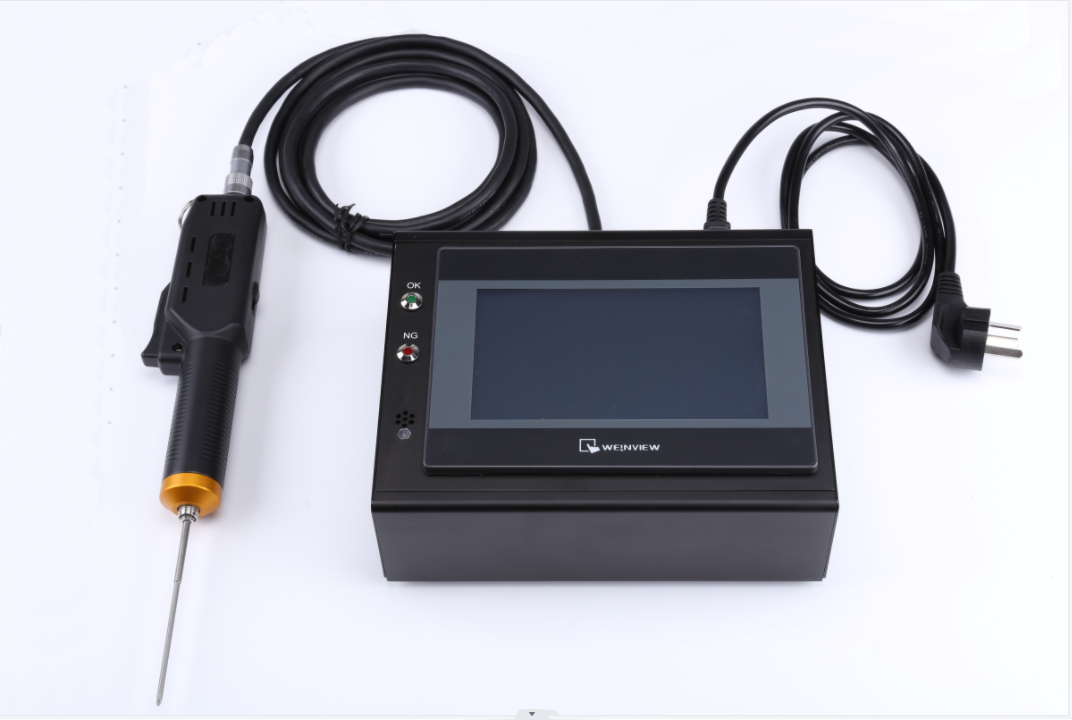
The following section introduces the differences between servo-powered electric screwdrivers and conventional electric screwdrivers in terms of speed, precision, service life, and cost.
1. Speed
Servo screwdrivers offer advantages such as high output torque, fast response, high speed, low inertia, smooth rotation, and stable torque. Their rated speed typically ranges from 1,200 to 2,000 rpm, and the speed can be set according to individual requirements on the controller.
2. Accuracy
(1) Servo screwdrivers can achieve high-speed, real-time detection and high-precision control of tightening torque values, ensuring the accuracy of torque application.
(2) Servo-powered screwdrivers, based on servo control technology, can ensure that the torque accuracy for million-cycle tightening and assembly remains within a standard deviation of ≤3%.
(3) The controller interface displays in real time the key data of the tightening process: actual torque value, angle value, process duration, and pass/fail status. If any unexpected issues arise during the tightening process, they can be promptly detected and corrected.
3. Lifespan
The service life of a servo-powered electric screwdriver is typically 1 million cycles—3 to 5 times longer than that of a conventional electric screwdriver. Generally, conventional electric screwdrivers don't last very long; after just 1 to 2 years, they usually reach the end of their useful life. In contrast, servo-powered electric screwdrivers can easily last 3 to 4 years without any major issues.
4. Costs
Considering both the overall cost and usage time, the cost of using a servo-powered electric screwdriver is not significantly higher than that of a conventional electric screwdriver. Moreover, using a servo-powered electric screwdriver can greatly reduce the production complexity for enterprises.
5. Intelligentization
The data from each tightening operation performed by the servo electric screwdriver is automatically saved, allowing you to trace and review the data at any time. Additionally, the data can be uploaded to the cloud or to an MES system. The servo electric screwdriver also features waveform acquisition during the tightening process, enabling technicians to view and analyze the waveforms for further evaluation or application.
The above is a sharing about the comparison between servo screwdrivers and conventional screwdrivers. If you'd like to learn more, please visit the Sensewee official website homepage and call our service hotline.
Previous article
Next article
Relevant Information
Introduction to Smart Electric Screwdrivers
2023-08-19
How to use a smart electric screwdriver
2023-06-12
SenseweeA reliable partner brand you can trust.

Copyright & ©2025 Shenzhen Sensewee Intelligent Technology Co., LTD All rights reserved
SEO
Technical Support:Chinese Enterprises Cross-border Shenzhen
Persistently build a comprehensive service system for our customers and continue to lead the future through innovation.
Sales Engineer (Huang Sheng)
Sales Engineer (Shi Sheng)
Sales Engineer (Lu Sheng)
Address
Building G, Room 608, Longjing Science and Technology Park, No. 335 Bulong Road, Shajing Subdistrict, Longgang District, Shenzhen City, Guangdong Province
Copyright & ©2025 Shenzhen Sensewee Intelligent Technology Co., LTD All rights reserved
SEO
Technical Support:Chinese Enterprises Cross-border Shenzhen
在线客服添加返回顶部
右侧在线客服样式 1,2,3 1
图片alt标题设置: Remember to modify: Company Name
表单验证提示文本: Content cannot be empty!
循环体没有内容时: Sorry, no matching items were found.
CSS / JS 文件放置地